
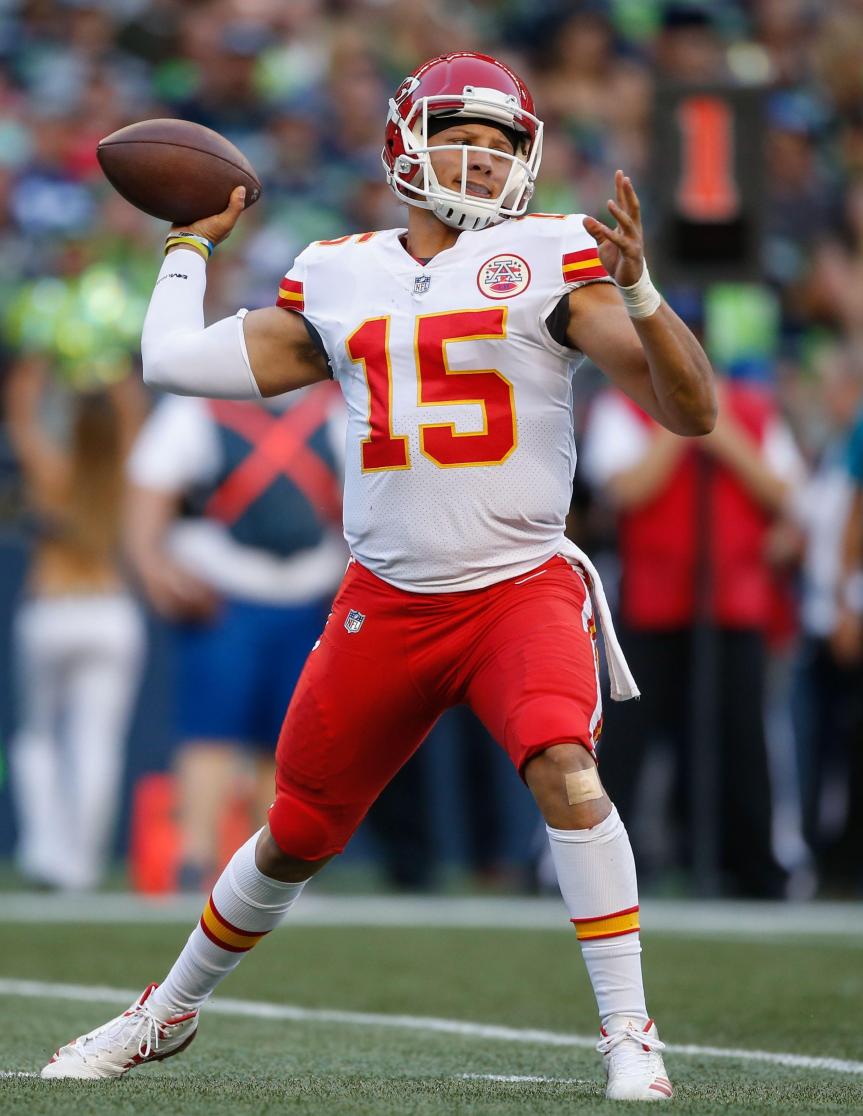
At the time, it was viewed as “unprecedented,” “massive,” and “historic.” A football deal that would reshape the landscape of quarterback contracts. That summer of 2020, the Kansas City Chiefs, fresh off their Super Bowl victory after a 50-year drought, made their first order of business clear: secure their star quarterback, Patrick Mahomes, for the long run. Little did they know that this monumental contract would appear as a bargain in the ever-evolving world of NFL deals.
Inking Mahomes to a ten-year contract extension worth a total of $450 million, with an initial fully guaranteed amount of $63.0819 million and a $10 million signing bonus, the Chiefs made a statement that reverberated throughout the league. This deal far surpassed any prior quarterback contracts, setting a new standard of financial commitment to a single player. The era of ten-year quarterback deals had begun, with Brett Favre, Drew Bledsoe, Donovan McNabb, Daunte Culpepper, and Michael Vick being the early pioneers in this territory.
However, Mahomes’ contract took everything to another stratosphere. The staggering average of $45 million per season caused jaws to drop. The quarterback was tethered to the Chiefs until 2032, bypassing potential free agency for over a decade. The chairman of the Chiefs, Clark Hunt, praised Mahomes’ remarkable talent and leadership, expressing delight in having him as an integral part of the Chiefs’ future.
Analysts immediately recognized the seismic impact of this deal. Pro Football Focus applauded the contract’s transformative effect on the NFL contract landscape, foreseeing the repercussions that would span decades. However, what truly stands out is their prediction that this deal could eventually be seen as a discount for the Chiefs. Their hypothesis considered a potential rise in salary caps driven by NFL league revenues and compared Mahomes’ contract to those of Aaron Rodgers and Russell Wilson, pointing out that it could be a lower percentage of future salary caps.
Fast forward to the present, and their prediction is coming true. Several quarterbacks have surpassed Mahomes’ deal in both average annual value and guaranteed money. The Los Angeles Chargers’ signing of Justin Herbert added another quarterback to the list of those with higher AAV than Mahomes. Furthermore, eight quarterbacks hold greater total guaranteed money, and 11 surpass Mahomes in fully guaranteed money.
Yet, despite these developments, Mahomes’ contract still offers the Chiefs flexibility. The structure allows the team to reclassify most of his compensation as signing bonuses, resulting in a lower cap hit. Currently, Mahomes’ 2023 cap charge accounts for 18.08% of the Chiefs’ cap, closely aligning with PFF’s predictions for 2025.
When calculated with the return on investment in mind, this deal becomes an overpowering bargain for the Chiefs. Since signing the extension, Mahomes has led the Chiefs to two more Super Bowl appearances, including a victory in last February’s game. He consistently displays top-notch performance, earning him an MVP title, and a place among the First-Team All-Pro for the second time in his career.
Drawing intriguing parallels to the story of Drew Bledsoe and Tom Brady, who replaced him and went on to achieve unparalleled success with the New England Patriots, it suggests that Kansas City may be experiencing a similar scenario. Historically, Brady remained underpaid throughout his tenure with the Patriots, allowing the team to maintain roster flexibility around him. The Chiefs’ situation might be heading in a similar direction, presenting the potential for untapped success.
 The Business Press