
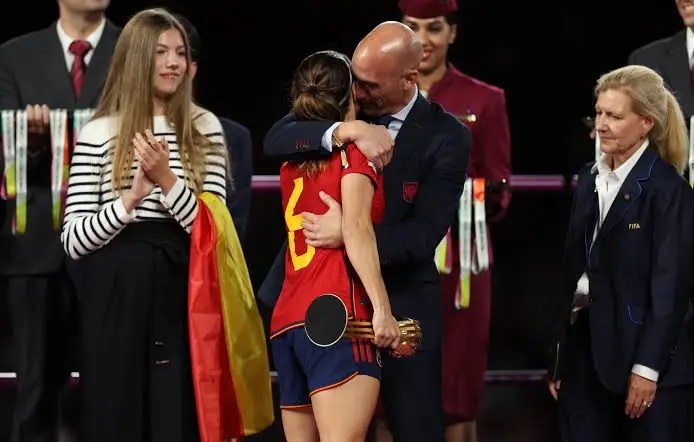
Luis Rubiales, the president of the Spanish soccer federation, has found himself embroiled in a scandal that has not only tarnished his reputation but also cost him his job. The incident unfolded during the Women’s World Cup awards ceremony, where Rubiales’ actions ignited a firestorm of outrage. His subsequent suspension by FIFA and mounting calls for his permanent removal have left Spanish soccer at a crossroads.
Luis Rubiales’ reputation had already been marred by previous scandals, but it was his conduct during the final match in Sydney, Australia, that proved to be the final straw. Offending millions worldwide, Rubiales kissed a player and made a vulgar gesture by grabbing his crotch in a misguided victory celebration. The backlash was immediate and severe, with Spanish Minister María Jesús Montero asserting that Rubiales could never again lead Spanish soccer.
FIFA took swift action, provisionally suspending Rubiales for 90 days. However, he stubbornly refused to step down and defiantly dismissed the situation as a “witch hunt” orchestrated by “false feminists.” The crisis deepened when Rubiales claimed that forward Jenni Hermoso had consented to the kiss, prompting Hermoso to refute this, asserting that she was a victim of an abuse of power. The exchange escalated further with allegations and threats of legal action from both parties.
The Spanish government has taken steps to remove Rubiales permanently, filing a lawsuit for his alleged abuse of power and actions that compromised the dignity and decorum of a sporting event. The Administrative Court for Sports will soon convene to assess the situation and potentially deem Rubiales unfit to hold office. As his suspension took effect, Rubiales’ vice president Pedro Rocha assumed the role of interim chief. However, Rocha’s close association with Rubiales has raised concerns about impartiality.
Rubiales’ actions have not only tainted the greatest feat of Spanish women’s soccer but have also fractured the federation. While he received sporadic support at the general assembly, a significant number of resignations, including that of the vice president in charge of women’s soccer, exposed the erosion of confidence. Key figures, such as Spain’s men’s coach Luis de la Fuente and women’s coach Jorge Vilda, initially applauded Rubiales but swiftly disavowed him after FIFA’s intervention. Public support overwhelmingly favors Jenni Hermoso, with numerous athletes, clubs, and political parties condemning Rubiales’ behavior.
Luis Rubiales, a former player and union leader, ascended to the presidency of the Spanish soccer federation in 2018. Despite controversy, he bolstered internal support by increasing revenues and securing major deals such as the revamp of the Spanish Super Cup. However, his tenure has been marked by controversy and allegations of abuse of power. His hopes of securing a joint bid to host the 2030 men’s World Cup now hang in the balance, pending his ability to salvage his position amid mounting opposition.
The fall of Luis Rubiales represents a turning point for Spanish soccer. His misguided actions and mismanagement have damaged the reputation of the federation and drawn widespread condemnation from within the sport and beyond. As the legal proceedings unfold and FIFA’s suspension persists, Spanish soccer finds itself at a critical juncture. The resolution of this scandal will determine the direction and future integrity of the sport in Spain.
 The Business Press